Why we have a worsening problem
Contents
Thumbnail
More Concise
Why we have a worsening problem
THE CONSENSUS ON WHAT IS NEEDED
SURELY THE NET ALREADY PROVIDES THE MEDICAL IMFORMATION PROFESSIONALS AND CONSUMERS WANT? WHY IS THERE A PROBLEM?
There are more than 30,000 health net sites; there are on-line medical texts and search engines for medical journals - and yet all the above suggests there is a serious health information problem. The WIM report suggests five years of work to standardize the treatment for 15 diseases and a billion dollars worth of research in the area. Here is why:Consumers
If you are among the hundreds of thousands each day who discover that either you or someone close has a serious health issue, the following is likely to be your initial experience.
In an earlier era when our understanding of disease and the range of treatment responses was much more limited, the patient role was largely passive. The doctor told you what was wrong and what was going to be done to treat and manage the problem.
Times have changed culturally and technically. Willingly or unwillingly patients are now involved in their own management and often it is not even an option not to be involved. Dr George Annas, the Chairman of the Health Law department at the Boston University School of Public Health said recently, "Many doctors are comfortable now saying, 'It's not me, it's you, and you're the one who has to decide.' I think people have some responsibility for their own decisions. Patients should accept this as part of the price of the wonders of modern medicine." 2
Because of the pace of medical change, it is now the rule rather than the exception that a number of very different management pathways are open. Medical litigation means that there is considerable pressure for the patient to make the decision rather than the doctor. Coming to grips with the problem and the management options is complex and time consuming and doctors have little time available for this discussion role. There are also additional contentious issues of the degree to which they may be in command of the latest information themselves and the skills they have in imparting it.
So whether by default, where the doctor requires you to make the choice, or simply because you wish to be involved yourself in this critical decision making, it is highly likely that you are about to discover ‘health on the net’
This experience is now very well documented by those who have been down the path.
To begin with, simply the stress of the discovery of the problem means it is difficult just to have the presence of mind required for the exercise.
When you turn to the Internet you will find an ocean of data. The problem is discrimination, not knowing what you are looking for and not knowing when you’ve found it. Having printed a stack of articles that seem to be relevant, you will find that your doctors have not the slightest interest in wading through it and vetting it all for you.
You will realize that media advisors who suggest you discriminate information sources by checking the writer’s credentials and cross checking the information between sources have never had to attempt such an impossible exercise themselves. Some people, sensing the technical problems and the importance of their own input, have even hired a full time researcher to try to do the job for them.
This very complicated and distressing experience is well documented in the quality media and the medical journals. E.g. On Oct 3, 2000 in the N Y Times there was an account of the experience of Mayor Giuliani and seven other men of relative power and education and the difficulties even they faced in gathering information about prostate cancer and charting a course through the complexities of the decisions. One of them was the Chief Financial Officer of the American Cancer Society. 1
The requirement that patients now shoulder the responsibility for retrieving and interpreting information related to major medical decision-making and the difficulties entailed was well documented in a New York Times June 25 report. "It is an overwhelming task for women, and consumers in general, to be able to sort through the information they find and make decisions," said Amy Alliana, the program director of the National Women's Health Network. "Patients are in the position of having to do a lot of work on their own." 2
It is absurd that every day hundreds of thousands of people with a new diagnosis of very common major diseases like breast cancer, prostate cancer or coronary artery disease confront the issue as if it existed for the first time for them alone. In a high tech society, awash with information and expertise we seem unable to circumvent this endless recurrence.
By examining the treatment of for example, ischemic heart disease (still the leading disease burden in the developed world), the adequacy of existing offerings of community health information can be readily tested. Regrettably all that we can find are inadequate when put to this test. Appendix B describes this process in more detail.
In a recent survey by Technologic Partners, 60% of all patients said they used the Internet for health research. In contrast this was recommended by only 4% of doctors. Doctors are very wary of community net health information, partly for good reasons.
In a recent interview with the N Y Times, Dr Victor Strecher, the Associate Director for Cancer Prevention and Control at the University of Michigan's Comprehensive Cancer Center in Ann Arbor, said, "Huge numbers of my patients come in with stacks of information from the Web and demand, 'See, this is what I've learned; now, what do you know?'" He noted, "Anybody can put anything out on the Web, and patients are inundating physicians with all this information and expecting us to sort out the proven from the suspect from the absolutely dangerous." It is a daunting task, particularly when an ever-greater number of patients are asking time-pressed doctors to do it.
‘The problem,’ said Dr. Donald Palmisano, a New Orleans surgeon and a trustee of the American Medical Association, ‘is that given the uneven quality of data on the Web, do-it-yourself medical research does not necessarily make a more informed patient. Nor does lugging journal articles to a checkup create the ideal beginning for a productive doctor-patient dialogue.’ 3
In spite of the current problems the American Medical Association is in favor of the move to active patient involvement. On March 21, 2000 in the Journal of the American Medical Association, the group said, ‘The Internet has the potential to speed the transformation of the patient-doctor relationship. It could move from one where the doctor is entirely in charge - with sometimes-questionable patient understanding and adherence to advice - to one that involves shared decision making’. They continued, ‘However, several substantial barriers remain before this relationship can be realized. These barriers include [lack of] equitable access to information, imbalance between patient health literacy and the information provided, extreme variation in the quality of the content, potential for commercial interests to influence content, and uncertain preservation of personal privacy.’
The issue for the majority in the community is that the future transition to a new relationship referred to by the AMA has already taken place. The revolution has already happened without AMA blessing and without the informational support facility. 4
Media and researchers’ view of community health information net sites
Numerous journal and media reviews of the major health net sites have pointed out their many problems, with their common advice being 'user beware.' There are articles on how to try to filter information, check the writer’s credentials, evaluate a net site and so on. The advice seems surprisingly naïve given the difficult, frustrating experience of the many intelligent people who have been through the process. The advice is given no doubt on the presumption that this is the best we have available and we have to ‘make do.’
Jane Brody’s Aug 31, 1999 N Y Times article, ‘Point-and-Click Medicine: a Hazard to Your Health’ is typical. 6 7
Should we simply return to the passive patient era?
Those who would prefer not to be involved themselves and suggest a general return to patient passivity might consider the likely outcome given the current revelations on the quality of medical decision making.
- Doctors and patients
Some three or four decades ago the prevailing cultural and medical climate largely supported the ‘passive patient’ model. Doctors made all major medical decisions and told patients what they thought they needed to know.
- Community information
Community information was a mix of low level ‘Reader’s Digest’ info-tainment articles and home encyclopedia level background material.
- Changes
The following developments started to combine to gradually produce a shift in the doctor/patient relationship – a shift that became radical by the turn of the millennium:
- The rise of consumerism.
- The decline in medical authority.
- The great increase in the number and complexity of medical, surgical and preventive options.
- The increase in medical litigation.
- An exponential increase in the volume of new medical information which greatly reduced the capacity of doctors to be in charge of all the medical ‘facts’
- Ironically - the potential availability of sophisticated health information on the Internet.
- Community information
- Doctors and patients
Since the late eighties there has been a dramatic shift to ‘active patient’ involvement in medical management. This was driven by evolving cultural issues indicated above but also by the presumed availability of sophisticated health information on the net. Time pressed doctors wary of litigation have been only too pleased to shift the burden of ever more complex decision making to patients - even to very unwilling claimants of this newfound responsibility. The mainstream patient at the turn of the millennium is now the ‘active’ patient.
Community health information users are now far from an homogenous group and consist of three very different sub groups with utterly different requirements.
- Those interested in infotainment (grapefruit diets,‘10 ways to ward off cancer’ articles)
- Those interested in general background ‘Readers Digest’ or home encyclopedia level articles about health issues.
- Those who need a complete up to the minute understanding of a topic often for urgent personal reasons. They have requirements vastly more sophisticated than the above two groups - in fact they require a layman’s equivalent of the best specialist understanding.
- In the beginning
- When the net entered the community mainstream in the nineties, an anythinghealth.com gold rush mentality pervaded.
The pre-existing body of community level health information was distributed over myriad dictionaries, magazines and home encyclopedias like the ‘Rush-Presbyterian-St. Luke’s-Medical Center Encyclopedia’.
Community databases were generated by collecting thousands of these articles, filtering the worst of them and blessing the remainder with the wand of ‘high level editorial oversight.’ These articles are usually very dated - often up to five years old. They were not written by doctors and were never intended to function as other than background information. Listing the professors of medicine on the site editorial committee meant only that these articles were suitable as partial background material and hopefully were free of the grossest errors. The implicit assumption was that a doctor somewhere was providing all the important decision making information.
As the net health portals condensed into the mega sites the same material was simply aggregated into indexed super collections of articles. WebMD aggregated many such sites. Community health net site design was simply the sum of many short term, narrow focus, corporate decisions. The commercial pressure was simply to get a site up as fast as possible - the momentum behind the process was enormous and billions of dollars were at stake.
- When the net entered the community mainstream in the nineties, an anythinghealth.com gold rush mentality pervaded.
- But the user base was rapidly changing in its requirements
- All the while the ground was shifting radically. No one paid attention to the fact that the majority community user’s needs were also evolving very quickly and in a way not paralleled by the net sites. The net sites were built around a model that was somewhat out of touch with trends in the in the late eighties but by the year 2000 it was almost irrelevant to mainstream need. Community information seekers had developed very sophisticated requirements. Few were reading now just for background information and certainly not for info-tainment. Willingly and unwillingly the community was very frequently taking on the role of co-decision maker and often sole decision-maker concerning major health issues. This meant that the requisite community level information now needed to be equivalent to that of an up-to-the-minute specialist.
The designers of health information net sites failed to focus on the end users with any degree of clarity. No one in the net health information business has ever set out to produce material, which explicitly responds to the real needs of user group 3 above. New community net site material is still produced entirely on the ‘passive patient’ model.
- All the while the ground was shifting radically. No one paid attention to the fact that the majority community user’s needs were also evolving very quickly and in a way not paralleled by the net sites. The net sites were built around a model that was somewhat out of touch with trends in the in the late eighties but by the year 2000 it was almost irrelevant to mainstream need. Community information seekers had developed very sophisticated requirements. Few were reading now just for background information and certainly not for info-tainment. Willingly and unwillingly the community was very frequently taking on the role of co-decision maker and often sole decision-maker concerning major health issues. This meant that the requisite community level information now needed to be equivalent to that of an up-to-the-minute specialist.
- The user response
- Users have responded by simply attempting to press the Internet into the service of their new requirement. There are two large hurdles.
The first is that this ocean of general background community material varies enormously in quality. A Johns Hopkins/Ohio State University study showed that some 70% is just wrong or misleading. The Journal of the American Medical Association confirmed in a survey of the top six consumer sites in May 2001 what many previous reviews and surveys had found. Even as background information, the ‘best’ of the consumer sites have typically 40% error rates and even trying to stick to ‘quality sites’ is relatively little protection.
The second and much larger hurdle is that the user has to go to the on-line medical journal research to upgrade this background material to the point where they can hopefully make meaningful decisions.
Unfortunately accessing this material is technically very demanding and time consuming - it is a daunting task for most doctors unless they work in the area of special research to generate this level of understanding from the thousands of journals and the Internet search engines like Medline.
The major community health information net sites are quickly passed over in the search process. People are then randomly sampling research material or trying to access this material through third party commentary in chat groups etc - a very risky process. The result is that the community is caught in this terrible bind - there is no going back to a ‘Marcus Welby golden age’ and the existing system is extremely difficult to manipulate to the new ends required.
- Users have responded by simply attempting to press the Internet into the service of their new requirement. There are two large hurdles.
- The outcome
- The outcome has been awful. Doctors hate patients turning up with great bundles of net articles and simply refuse to play editor to the material - for both good and bad reasons.
Many review articles document the severe problems the community now experiences in this process. Surveys show that the vast majority of the ~50m users per month of net health information are there not there for info-tainment or simply for general backgrounding. They are in need of an up-to-the-minute understanding of serious health problems often for urgent personal reasons. There is a very high rate of community dissatisfaction with the process but the cultural trend is inexorable and accelerating.
- The outcome has been awful. Doctors hate patients turning up with great bundles of net articles and simply refuse to play editor to the material - for both good and bad reasons.
Attempting to follow these guidelines in researching any major health issue is particularly instructive for anyone wanting to test the viability of the current system.
Professional Health Information and Clinical Decision Making
Until this year and the WIM report there was a much less publicized but more serious problem for doctors - just being in command of the appropriate information themselves. It is the major component of the closely related issue - the quality of clinical decision making. The central concern is ‘clinical drift’, where the evidence indicates doctors can fall years behind the working edge of medicine and where information updating has become a ‘hit and miss’ process of patching an already patchy personal database. The sheer complexity of the task and severe time constraints means that often only some of the university-based research specialists can stay well up with a field. Those in routine clinical practice, including specialty practice, tend to drift, sometimes well behind the research, even in their own fields.
The lag is sufficient to seriously concern the medical and surgical colleges, raising issues of competence not just information currency. Additionally there is little demand pressure from the community as a wad of research papers from Who-knows-what.com is easily dismissed even when it does contain some relevant piece of information. The problem for doctors is that the net services still leave the vast bulk of the of the job untouched - selecting, condensing and collating the relevant information - updating and patching the doctor’s personal understanding of each field. The net simply brings the same truckloads of information more efficiently to the doctor’s door.
For this reason (and the lack of consumer pressure), doctors have been completely under whelmed by the net revolution.
This is why they don’t use the professional sites no matter what the marketing incentives - not because they are conservative, reactionary, luddites out of touch with technology as many commentators have suggested in explanation.
On October 25, 2000 Abigail Zuger M.D., physician and writer for the N Y Times, said in a review of the web as an information resource for doctors, ‘Harvesting medical information off the Web is no less tricky for professionals than it is for anyone else ... Practicing medicine from the partial information on the Web is as dangerous a habit for doctors as it is for anyone else'. 8
Modern medicine is a mere 40 years old. It is only since the sixties that we have had moderately successful treatments for many of the major diseases. The presumed mechanism by which doctors do keep up to date is unchanged in principle from fifty or even a hundred years ago. Doctors have a store of clinical information in memory which they update by taking CME courses, reading the journals, talking with colleagues and attending conferences. There have been dramatic changes in the whole relationship of doctors to medical information in the last forty years. Few of them have been well documented but the most commonly understood is the issue of the volume of information.
The volume of medical information
This period has been characterized by a gradual shift towards an exponential rate of growth of medical information and the doubling rate is now 2-3 years. Some 1600 significant medical articles per day are being published. Some fields of medicine and surgery are moving so swiftly that being a few months behind the research can be very significant
Multi-faceted approach to the diseases
With the increasing sophistication of medicine, many diseases are now distributed over a clinical spectrum much broader than the traditional specialist categories. In particular medicine and surgery are closely intertwined in the treatment of many disorders. The proliferation of new treatments means many diseases have fast evolving alternative management strands rather than simply a single treatment option. The management strands often intertwine previously discrete areas like internal medicine, surgery, radiology, pharmacology etc and areas that are newly emerging like prevention and screening. Preventive and screening approaches are now also well-developed areas of clinical practice and primary care has a defining contribution.
Interconnected medicine raises the knowledge bar for everyone
Increasingly clinical knowledge areas are interrelated and interconnected.
The rise of interconnected medicine means that a doctor now needs to be familiar with the very many ways that both closely related and seemingly disparate areas of medicine impinge on their individual field. So the domain of knowledge is no longer defined largely by the practitioner’s field of operation but by the very much larger field of medical knowledge that now interacts with a practitioner’s own working field. Physicians need to know about current surgical options and vice versa. Generalists like those in emergency rooms need to know about advanced diagnostic, medical and surgical treatment options so that patients can be quickly triaged and appropriately pre-treated.
The arena of necessary shared clinical knowledge now includes an understanding of the clinical components of specialist knowledge - what the specialist can do without the detail of how that is achieved. The challenge is to communicate this level of information whilst constraining the total volume of information needing to be taken in.
At a time when command of their own medical fields is very difficult the knowledge bar has been raised further to the level where a working knowledge of many other fields is necessary knowledge. The boundary of an individual’s own clinical activity no longer defines the boundary of necessary clinical knowledge for that activity.
For a primary care doctor, hospital based generalist or a specialist to be clinically capable in their own domain a good grasp of the state of clinical development in other fields both close and distantly related is often now necessary.
A dramatic shift in the relative use of clinical information resources
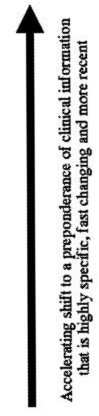
The following table shows how the different categories of clinical information are layered, how they function and how there is a major shift from the broader older resources to the narrower faster changing resources.
| Level 1
INDIVIDUAL AUTHOR RESEARCH ARTICLES | Journals E.G. Use of a particular drug for treating blood pressure |
| Level 2 INDIVIDUAL AUTHOR RESEARCH REVIEWS | Journals E.G. The pharmacological treatment of blood pressure | |
| Level 3
INSTITUTIONAL TOPIC REVIEWS | Medical Colleges, Research Centers, hospitals E.G. The pharmacological treatment of blood pressure | |
| Level 4
LARGE MULTI-CENTER TRIALS | Major Research Centers E.G. The treatment of blood pressure and stroke prevention | |
| Level 5
EVIDENCE BASED MEDICINE COLLECTIONS | E.G. Cochrane Collection, EBM net site. Collections of summaries of the best evidence from sub categories within many different within topics E.G. The use of beta blockers in heart disease | |
| Level 6
TEXTS | Medical, Surgical, Primary Care, Screening and Prevention across a broad range of disease topics |
The above Table illustrates the structure of the clinical resources available to a doctor. There is an approximate gradation in the table.
In general at the top (Level 1) is the narrowest and most recent information and at the bottom is the broadest and oldest. Approximate as it is, the table is useful in visualizing a very important trend in information resource usage. Forty years ago the bulk of the important clinical information was derived from Level 6 - the medical texts. The now near exponential rate of increase in research particularly in diagnostics and treatment has shifted the preponderance of important clinical information to the upper Levels, chiefly to Level 1, the zone of some 1600 new articles per day. Medicine continues to centrally depend on an evolving core of gold standard research for its underpinnings – the multi-center clinical trials, the large pooled studies, the considered evaluation of the major committees of the colleges and institutions.
The traditional standard of clinical research remains the multi-centre clinical trial, that is – Level 4. But those trials require treatment and diagnostic regimes to be stable for such an extended period (some years) and they then take years for the trials to be conducted.
The pace of research means that the proportion of much more recent large and smaller scale studies to these landmark studies has increased enormously. Moreover this fast paced research is often in critical areas like new or alternative treatments for major problems. It is often not feasible to wait for more scientifically secure major supporting research. Clinical decisions must often be made now on ‘softer’ less scientifically ideal grounds. This development trend means that the evaluation of very recent research both large and small scale is an increasingly critical component of medical updating.
As a consequence an increasingly important role for the clinician is making a best judgement call based on limited data in critical fast changing areas. For example a small study showing modest success for a new treatment of an otherwise lethal disease is very important and the clinical decision cannot wait for the long term trials to be completed, if they ever are... Rapid development of new diagnostic techniques and multiple alternative treatments in particular means that a large and inevitably increasing proportion of underpinning clinical research is now in this category. Where there are new potential treatments for previously untreatable diseases or more usually significantly better alternatives to the current treatment options many decisions now have to be made on the basis of less than the gold standard ideals of scientific evidence. At the moment this segment is handled in a completely ad hoc fashion. Currently a very large quantity of important information is either ignored, or taken on naively or handled in isolation with varying degrees of skill. This shift to a clinical emphasis on the most recent research and the need for special evaluation skills has occurred of course at the same time as the volume of material has exploded.
The conscientious clinician is still faced with the following information management problem:
- The increasing rate of progress in medicine, and the lag time in medical text publication, means that traditional medical texts are declining in usefulness.
- Even the best of the on-line medical texts is updated annually meaning the research is up to two years out of date in spite of occasional text ‘supplements’.
- The major online texts are texts of internal medicine meaning that further text material has to be supplemented from surgical texts, primary care texts, screening and preventive care texts, best practice, clinical trial and drug databases.
- All of the above also has to be supplemented from the many relevant journals over the last one to two years - a particularly arduous process.
- Information in traditional medical texts is often poorly structured for ease of access and efficient usage.
- Updating a research base from a resource like Medline is numbingly complex, when a search on a single domain topic can yield a quarter of a million abstract titles.
In contrast to the enormous number of consumer information sites there are only a small number of professional sites. Again in contrast to the consumer sites their information accuracy is very much better. They take widely varying approaches to the issue of professional information. One can locate their specific contributions to the field of medical information by using the table above. Some sites try to provide high volumes of new information. Medscape, the most famous, provides a big volume of indiscriminate esoteric research titles from across all of medicine on a weekly basis. It samples from the huge volume of Level 1 information unfortunately with very little discrimination. It is completely unmanageable and impractical for a doctor to use even for that level of clinical input. MDconsult provides a search engine to collect information from 40 variously dated e text books - terrific for Level 6 text information and would have been great fifty years ago when the bulk of information was actually contained at that level. Harrisons and Scientific American Medicine provide more contemporary texts of internal medicine on line. Eskolar out of Stanford understands the problem of integrating information levels but their solution is incredibly naïve clinically. They provide a search engine which electronically selects information from medical texts and the journals. The problem is we are generations away from having the expert systems that are remotely capable of the very high level of clinical discrimination needed to make this approach work. (In contrast an experienced clinician/researcher working in his own field can perform this task with surprising speed and efficiency.) Up-to-date attempt to provide a specialist level service by supplying a sample of specialty articles across topic areas but the result is extremely patchy and difficult to use. The Cochrane and EBM sites provide collections of evidence based medicine reviews - Level 4 on the table.
No site is attempting to collate and distil into a single usable format the widely varying information resources in the table above.
More Concise
Why we have a worsening problem
More Concise
Why we have a worsening problem
More Concise
Why we have a worsening problem
More Concise
Why we have a worsening problem
More Concise
Why we have a worsening problem
More Concise
Why we have a worsening problem
More Concise
Why we have a worsening problem
More Concise
Why we have a worsening problem
More Concise
Why we have a worsening problem
Next