Why we have a worsening problem
Contents
Thumbnail
Full Account
Why we have a worsening problem
THE CONSENSUS ON WHAT IS NEEDED
SURELY THE NET ALREADY PROVIDES THE MEDICAL IMFORMATION PROFESSIONALS AND CONSUMERS WANT? WHY IS THERE A PROBLEM?
In the last few decades, health care delivery has moved from the passive patient model, where the doctor told you what was wrong and what was going to be done to treat and manage the problem, to a situation where patients are now co-responsible for their health.Willingly or unwillingly patients are now involved in their own management and often it is not even an option not to be involved. Dr George Annas, the Chairman of the Health Law department at the Boston University School of Public Health said recently, "Many doctors are comfortable now saying, 'It's not me, it's you, and you're the one who has to decide.' I think people have some responsibility for their own decisions. Patients should accept this as part of the price of the wonders of modern medicine."
Because of the pace of medical change, it is now the rule rather than the exception that a number of very different management pathways are open. Medical litigation means that there is considerable pressure for the patient to make the decision rather than the doctor. Coming to grips with the problem and the management options is complex and time consuming and doctors have little time available for this discussion role.
When you turn to the Internet you will find an ocean of data. The problem is discrimination, not knowing what you are looking for and not knowing when you’ve found it. Having printed a stack of articles that seem to be relevant, you will find that your doctors have not the slightest interest in wading through it and vetting it all for you.
You will realize that media advisors who suggest you discriminate information sources by checking the writer’s credentials and cross checking the information between sources have never had to attempt such an impossible exercise themselves.
How did community health web sites come to be like this ? With the advent of the web, background information was collected from myriad sources and made available on the web. Little if any of this material was written by doctors - not a problem if all you want is interesting and informative background information. But a big problem if you need critical decision making information.
The US Federal Agency for Healthcare Research and Quality has published a guide to researching health on the net : Now You Have a Diagnosis What’s Next. Attempting to follow these guidelines in researching any major health issue is particularly instructive for anyone wanting to test the viability of the current system.
Professional Health Information and Clinical Decision Making
Until the WIM report of 2001 the more serious problem for doctors was much less publicized - just being in command of the appropriate information themselves. It is the major component of the closely related issue - the quality of clinical decision making. The central concern is ‘clinical drift’, where the evidence indicates doctors can fall years behind the working edge of medicine and where information updating has become a ‘hit and miss’ process of patching an already patchy personal database.
The lag is sufficient to seriously concern the medical and surgical colleges, raising issues not only of information currency but indeed of competence .
On October 25, 2000 Abigail Zuger M.D., physician and writer for the N Y Times, said in a review of the web as an information resource for doctors, ‘Harvesting medical information off the Web is no less tricky for professionals than it is for anyone else ... Practicing medicine from the partial information on the Web is as dangerous a habit for doctors as it is for anyone else'.
Modern medicine is a mere 40 years old. It is only since the sixties that we have had moderately successful treatments for many of the major diseases. The presumed mechanism by which doctors do keep up to date is unchanged in principle from fifty or even a hundred years ago. Doctors have a store of clinical information in memory which they update by taking CME courses, reading the journals, talking with colleagues and attending conferences. There have been dramatic changes in the whole relationship of doctors to medical information in the last forty years. Few of them have been well documented but the most commonly understood is the issue of the volume of information.
- The volume of medical information
- This period has been characterized by a gradual shift towards an exponential rate of growth of medical information and the doubling rate is now 2-3 years. Some 1600 significant medical articles per day are now being published.
- Multi-faceted approach to the diseases
- With the increasing sophistication of medicine, many diseases are now distributed over a clinical spectrum much broader than the traditional specialist categories.
- Interconnected medicine raises the knowledge bar for everyone
- Increasingly clinical knowledge areas are interrelated and interconnected.
The rise of interconnected medicine means that a doctor now needs to be familiar with the very many ways that both closely related and seemingly disparate areas of medicine impinge on their individual field.
- A dramatic shift in the relative use of clinical information resources
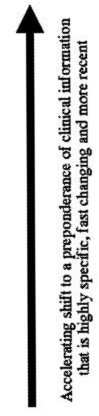
- The following table shows how the different categories of clinical information are layered, how they function and how there is a major shift from the broader older resources to the narrower faster changing resources.
| Level 1
INDIVIDUAL AUTHOR RESEARCH ARTICLES | Journals E.G. Use of a particular drug for treating blood pressure |
| Level 2 INDIVIDUAL AUTHOR RESEARCH REVIEWS | Journals E.G. The pharmacological treatment of blood pressure | |
| Level 3
INSTITUTIONAL TOPIC REVIEWS | Medical Colleges, Research Centers, hospitals E.G. The pharmacological treatment of blood pressure | |
| Level 4
LARGE MULTI-CENTER TRIALS | Major Research Centers E.G. The treatment of blood pressure and stroke prevention | |
| Level 5
EVIDENCE BASED MEDICINE COLLECTIONS | E.G. Cochrane Collection, EBM net site. Collections of summaries of the best evidence from sub categories within many different within topics E.G. The use of beta blockers in heart disease | |
| Level 6
TEXTS | Medical, Surgical, Primary Care, Screening and Prevention across a broad range of disease topics |
The newest information comes in at the top. By definition, this is scientifically "softer" than the lower levels - which have had longer to be verified by repetitions of trials, usually by different personnel at different centres. The further down the table we go, the harder the science. However, at the front line of research, a small study at a single center showing a modest success for a new treatment of an otherwise lethal disease is very important and the clinical decision cannot wait for the long term trials to be completed.
The Professional Sites
In contrast to the enormous number of consumer information sites there are only a small number of professional sites. Again in contrast to the consumer sites their information accuracy is very much better. They take widely varying approaches to the issue of professional information. Most notably : Medscape, MD Consult, Harrisons and Scientific American Medicine, Eskolar, and Up-to-date. The Cochrane and EBM sites provide collections of evidence based medicine reviews - Level 4 on the table.
No site is attempting to collate and distil into a single usable format the widely varying information resources in the table above.
Full Account
Why we have a worsening problem
Full Account
Why we have a worsening problem
Full Account
Why we have a worsening problem
Full Account
Why we have a worsening problem
Next